
AI exposes the integration tax in best-of-breed software
Best-of-breed software still has a place. Agents expose the integration tax humans used to absorb. The new stack test is whether systems are reachable, governed and clear enough for AI-assisted work.
Best-of-breed software still works when specialist tools are connected, governed and clear about where truth lives.
The weak version is the unmanaged stack: CRM, HR, finance, ticketing, docs, chat, task management and knowledge systems bolted together with human memory and manual tab-switching.
For the last twenty years, organisations could bolt together CRM, HR, finance, ticketing, docs, chat, task management and knowledge systems because humans absorbed the mess. People switched tabs, copied context, reconciled conflicting records, remembered which spreadsheet was the real one, and knew when the CRM was out of date.
Humans were the middleware.
AI changes that bargain. Agents do not handle ambiguity the way staff do. They need reachable systems, clear permissions, clean data models, authoritative records, audit logs, and safe ways to act.
The integration tax that humans quietly paid is about to appear on the architecture bill.
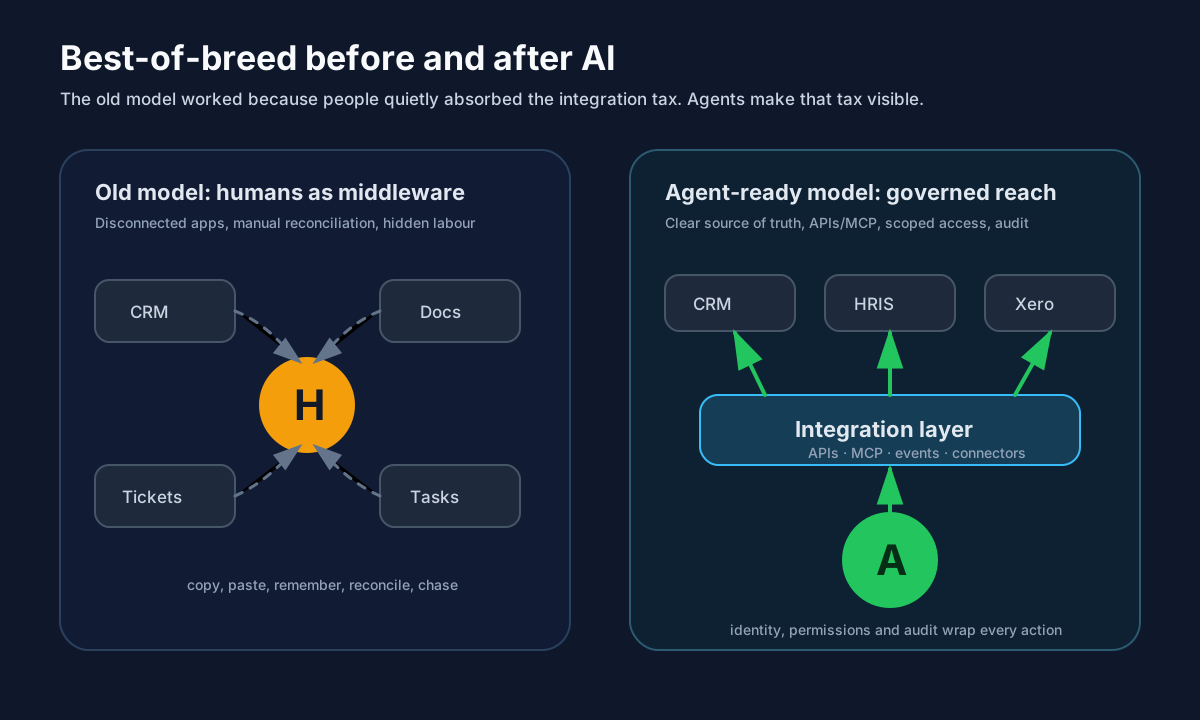
Diagram note: the issue is not specialist tools. The issue is making people or agents reconcile disconnected systems without a governed integration layer.
The shift: app-centric to agent-centric
The old operating model was app-centric:
- humans opened apps;
- humans navigated interfaces;
- humans created files;
- humans moved work between tools;
- humans remembered the context the software did not carry.
The emerging model is agent-centric:
- humans express intent, judgement, approval and correction;
- agents gather context, call systems, draft artefacts, update records and route work;
- apps become infrastructure underneath the interaction layer;
- files become outputs, archives, evidence, approvals or compatibility formats;
- systems of record matter more because agents need somewhere authoritative to read and write.
The interaction layer includes more than chat:
- chat;
- embedded copilots;
- buttons like “summarise this” or “draft reply”;
- meeting agents;
- voice and ambient context;
- scheduled agents;
- triggered workflows;
- agent-to-agent delegation.
Chat is one interface. The strategic layer is broader: how humans and AI systems interact around work.
The new stack
A useful AI-ready operating stack looks roughly like this:
-
Interaction layer
Chat, copilots, voice, buttons, ambient agents, scheduled triggers and approval surfaces. -
Agent/orchestration layer
The runtime that plans work, calls tools, checks state, requests approval, delegates and handles exceptions. -
Integration layer
MCP, APIs, connectors, webhooks, event streams and data contracts. This is the sleeper battleground. -
Systems of record
CRM, HRIS, finance, ticketing, support, policy, asset, client and operational systems. The places where business truth lives. -
File/artifact layer
Docs, PDFs, spreadsheets, slides and exports. Still essential, but increasingly as artefacts of work rather than the primary work environment.
Cutting across all of it:
- identity;
- permissions;
- audit;
- observability;
- data governance;
- versioning and rollback;
- human approval boundaries.
These layers form the spine of agentic operations.
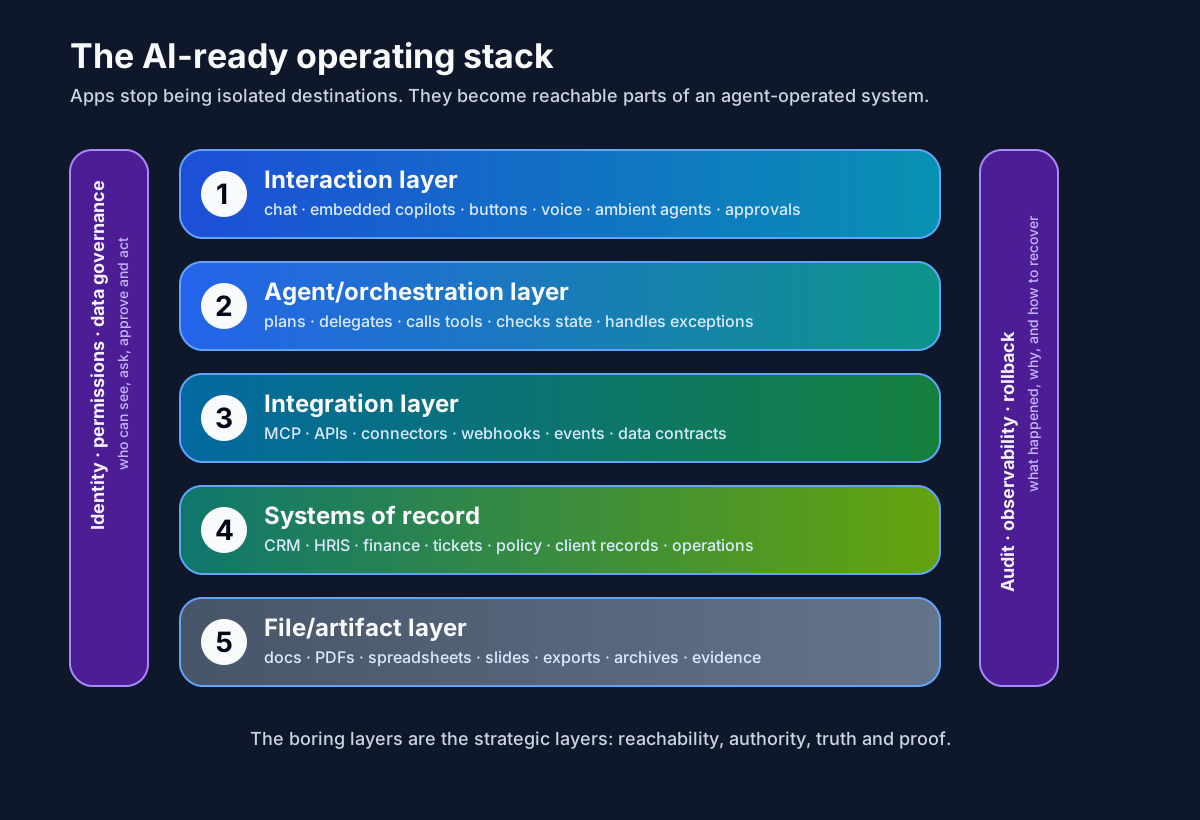
Diagram note: identity, permissions, audit and rollback cut through every layer.
Why best-of-breed gets harder
Best-of-breed worked when a tool only had to be good for the human using it.
The new test is harsher.
A system now has to be good for the human, the organisation and the agent operating on behalf of the human.
That means asking:
- can an agent reach it without screen-scraping?
- does the API cover what the UI can do?
- is there an MCP server or credible agent-access roadmap?
- are permissions scoped and auditable?
- can actions be attributed to the user, agent and workflow?
- does the system expose a clean data model?
- does it support events, webhooks, versioning and rollback?
- can it handle machine-speed reads and writes without breaking rate limits?
- is it clear whether this system owns the customer, case, task, policy, invoice or approval?
A beautiful UI with a weak API is no longer best-of-breed. It is a human-friendly silo.
The systems-of-record question
Systems of record become more strategic.
AI makes the decision about where truth lives urgent.
If customer data lives partly in Dynamics, partly in spreadsheets, partly in support tickets and partly in a project tool, the agent cannot safely know what is true. If policies live in Employment Hero, Confluence, Loop, Google Docs and PDFs in a drive, the agent will find the wrong one eventually. If Asana and Jira both hold tasks, neither is the source of truth unless the boundary is bright and enforced.
For humans, that is annoying.
For agents, it is operational risk.
The procurement question changes from “does this tool have the features our team wants?” to “can this tool safely participate in AI-run work?”
Procurement criteria for AI-ready systems
For new systems, agent-readiness should be written into the RFP.
Useful criteria:
-
Agent reachability
Comprehensive documented API, OpenAPI/schema support, MCP support or roadmap, webhooks/events, and no critical UI-only functions. -
Scoped identity
OAuth, service accounts, delegated access, workload identity, least-privilege scopes, and no “admin or nothing” automation model. -
Permission inheritance
Agents should act on behalf of humans or teams without bypassing existing access controls. -
Audit and observability
Every machine-initiated action should be attributable, timestamped, explainable and exportable. -
Data model integrity
Clean schemas, referential integrity, metadata, typed fields, controlled vocabularies, soft deletes, versioning and rollback. -
Concurrency and state handling
Safe behaviour when multiple humans or agents act on the same record, document or workflow. -
Rate limits fit for agents
Human-scale rate limits are not enough if agents are expected to perform bulk review, reconciliation or reporting. -
Interoperability over captive AI
A vendor’s built-in chatbot matters less than whether your agent layer can work with the system.
A vendor saying “we have AI” still has to prove the system can safely participate in AI-run work.
Teams, gravity and the realpolitik of stacks
Most organisations do not get to design this from a blank page.
They already have gravity.
If Teams is where the conversations, meetings, calendar invites, files, approvals and organisational habits live, then Microsoft is already part of the operating substrate. The organisation may still use Google Docs, Confluence, Asana, Jira, Xero, Dynamics and Employment Hero, but Teams creates collaboration gravity.
That creates a real architectural choice.
It does mean the decision is no longer neutral.
The strategic question becomes:
Given our existing gravity, how native do we go, and what do we deliberately keep outside the fence because it is worth the integration cost?
That is a better question than the old religious war between suites and best-of-breed.
A practical stack principle
The rule of thumb:
Consolidate by default. Diversify deliberately.
Keep a specialist tool when one of these is true:
- it is genuinely better in a way that matters;
- it owns a clearly bounded system of record;
- it is agent-reachable through strong APIs, MCP or connectors;
- it has strong permission and audit controls;
- replacing it would create more operational risk than integrating it;
- users are materially more effective in it and the integration cost is funded.
Otherwise, sprawl is not flexibility.
It is agent-hostile architecture.
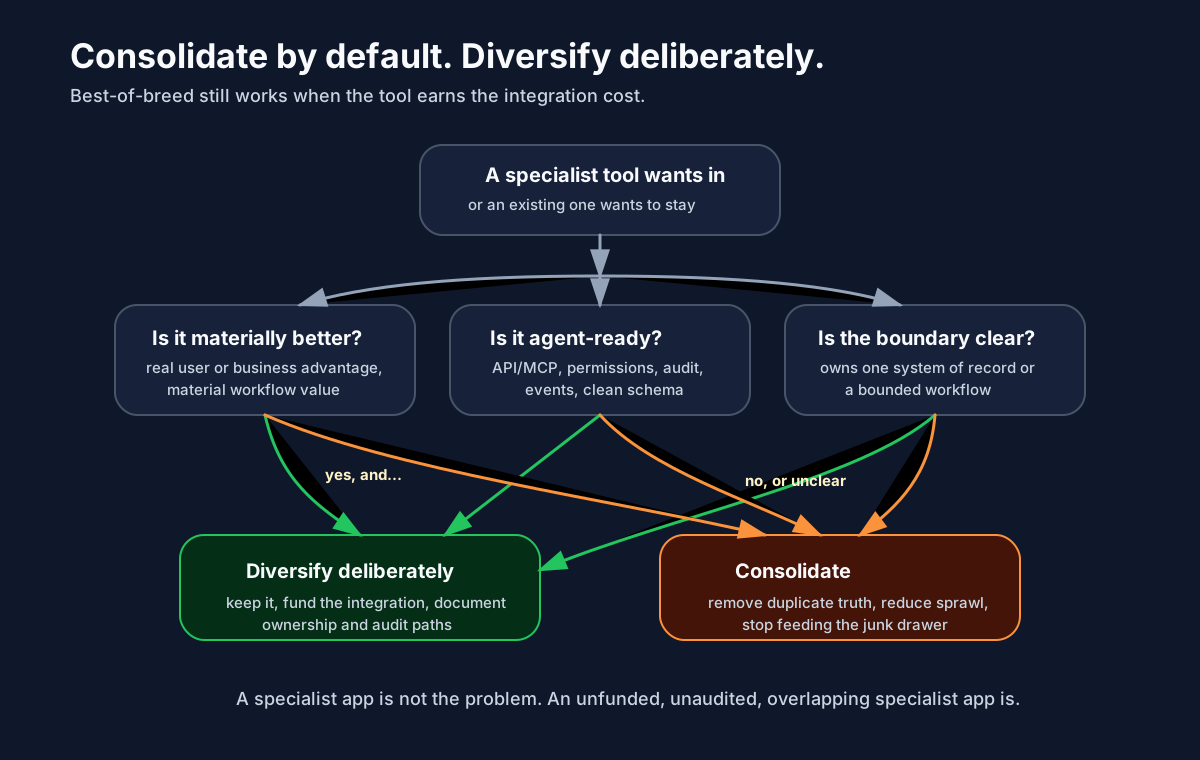
Diagram note: a specialist app can stay, but it has to earn the integration cost. Preference alone is not enough.
The counterargument
There is a real risk in over-consolidating.
If every organisation rushes into one vendor’s suite because that vendor has the cleanest AI story today, they may trade SaaS sprawl for platform lock-in. Microsoft, Google, Salesforce and Atlassian will all try to make their ecosystems feel like the safest place to run agents.
Sometimes they will be right.
Sometimes the better answer will be a vendor-neutral agent layer over a heterogeneous stack. MCP and similar protocols matter because they may reduce the pressure to consolidate by making cross-vendor work more reliable.
But that future is not evenly distributed yet. Today, most organisations are not choosing between a perfectly integrated suite and a perfectly integrated neutral agent layer. They are choosing between deliberate architecture and accidental sprawl.
Best-of-breed remains legitimate.
Best-of-breed needs funded integration, clear ownership and agent-ready access.
The new stack test
AI has made hidden stack architecture visible.
The question is no longer just which apps people like using.
The question is whether the organisation has an operating layer where AI can safely reach the right systems, act with the right permissions, use the right source of truth, produce the right artefacts, and leave the right audit trail.
That is the new stack test.
Best-of-breed can pass it.
The SaaS junk drawer cannot.
Quick signal helps Rob sharpen future briefings.